Greg Abbott, the governor of my home states of Texas, recently tweeted the following:
Abbott also recently tweeted this meme:
In fact, Abbott regularly provides us with tweets affirming the Christian faith. Apparently he sees no dissonance between affirmation of the God who came to us in Jesus Christ and the rejection of refugees who are fleeing for their lives. I don’t want simply to single Abbott out. There are twenty six other governors who have also expressed an unwillingness to receive Syrian refugees, most of whom probably self-identify as Christians. Nor do I want to question Abbott’s sincerity as a Christian.
I just think he’s wrong. He’s wrong to believe that affirmation of Christ and this wholesale rejection of Syrian refugees are compatible. They aren’t.
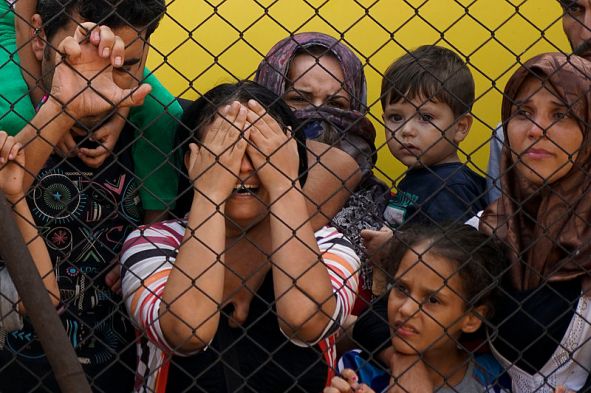
Photo by Mstyslav Chernov, courtesy of Wikimedia Commons
If you’ve never read The Cost of Disicpleship, run–don’t walk–to your nearest bookstore and pick up a copy. Take it home and devour it. It is a masterpiece of Christian literature and, though written in a very different time, a helpful guide for us today. In talking about the call that Christ puts on our lives, Bonhoeffer writes,
Since the coming of Christ, his followers have no more immediate realities of their own, not in their family relationships nor in the ties with their nation nor in the relationships formed in the process of living. Between father and son, husband and wife, the individual and the nation, stands Christ the Mediator, whether they are able to recognize him or not. We cannot establish direct contact outside ourselves except through him, through his word, and through our following of him. To think otherwise is to deceive ourselves (The Cost of Discipleship, Touchstone, 1995: 96-97).
For the Christian, Christ mediates everything. Therefore as we make decisions about the fate of Syrian refugees, those of us who are Christian must do so fully cognizant of the fact that Christ stands as a mediator between ourselves and all other interests that come to bear on these decisions, even the interests of the nation state.
Christians often have competing values and allegiances. We have allegiance to our nations. We have allegiance to our families and friends. We have allegiances to political parties. These types of allegiances are fine until they come into conflict with our allegiance to Christ. Christians have one Lord. Any claims that others make upon us must be subservient to our allegiance to Christ. Jesus was aware that obedience to him would cause conflict, that his among his followers there would be multiple claims upon their lives. He is insistent, however, that allegiance to himself is paramount:
Do not think that I have come to bring peace to the earth; I have not come to bring peace, but a sword. For I have come to set a man against his father, and a daughter against her mother, and a daughter-in-law against her mother-in-law; and one’s foes will be members of one’s own household. Whoever loves father or mother more than me is not worthy of me; and whoever loves son or daughter more than me is not worthy of me; and whoever does not take up the cross and follow me is not worthy of me (Matt 10:34-38).
In this time of great need, what does allegiance to Christ require of us? Responses to the Syrian refugee crisis that reject the homeless, the alien, the stranger, and the exile are incompatible with the values taught to us by Christ. We must reject such responses and press forward toward responsible actions that recognize the full humanity of these refugees and treat them with the dignity befitting human beings.
We now know that at least one of the terrorists involved in the recent attacks in Paris came into Europe in the tide of Syrian refugees. Do we therefore make ourselves more vulnerable to attack by allowing Syrian refugees into the United States? Perhaps, and perhaps not. But as we rightly show our concern for the people of this nation and the protection of our citizens, as Christians we must also demonstrate compassion for those who are strangers and aliens, having no longer any homeland, who are afraid and vulnerable. “Religion that is pure and undefiled before God, the Father, is this: to care for orphans and widows in their distress, and to keep oneself unstained by the world” (James 1:27).
Almighty and most merciful God, we remember before you all poor and neglected persons whom it would be easy for us to forget: the homeless and destitute, the old and the sick, and all who have none to care for them. Help us to heal those who are broken in body or spirit, and to turn their sorrow into joy. Grant this, Father, for the love of your Son, who for our sake became poor, Jesus Christ our Lord. Amen (Book of Common Prayer).
 David F. Watson
.jpg)
Amen. Thank you David.
Christian bigotry is not the proper response to Islamic terrorist groups. This is an occasion for authentic Christian love. Thanks for the post, David.
David, I think you are giving Texas Gov. Abbott and other politicians too much credit when you assume that their faith informs their political decisions and tweets. Aren’t their religious tweets just today’s version praying in public for their own benefit? What other purpose do they serve? These anti-refugee pronouncements are just a desire to gain public opinion over the Democrats. No? Is it just a coincidence that the same governors wanting to ban refugees are the same ones that fight the Democrats on every issue and voted for Romney in 2012? Why else would the current GOP candidates try to out do each other in banning refugees, to the point that Gov. Chris Christie says he wouldn’t even admit a 5-year-old orphan from Syria? It reminds me of the drummed-up hysteria over ebola. The day after the election, suddenly ebola wasn’t a threat to our country anymore. It will be the same with this issue. Are the Democrats models of Christian behavior? No, but at least on this refugee issue they aren’t fear-mongering. It’s really despicable.
It is a noble thing to put oneself at risk for the sake of serving another in the name of Jesus. It is a matter of taking up our cross. But what if that also means putting others at risk? Others who are not making that same choice for themselves?
Thank you, David! We are all aliens at one time or another and we scriptures tell us to welcome aliens. What are folks thinking? Fear makes us say the worst things!