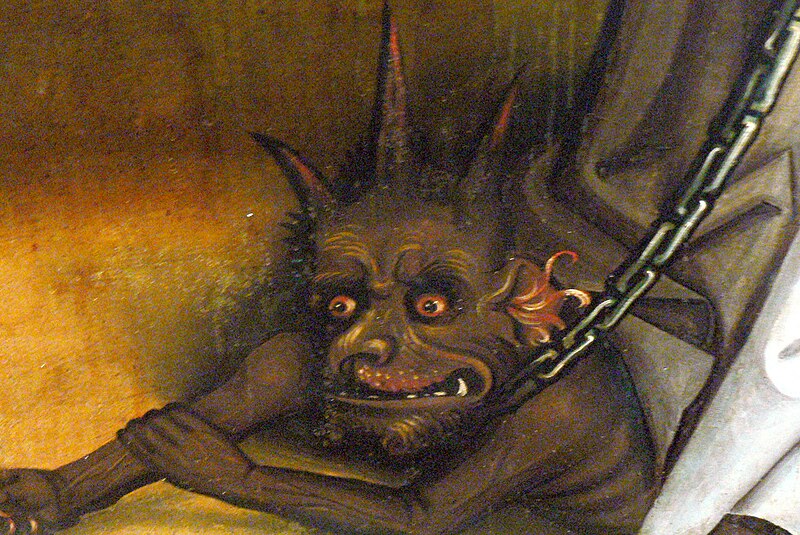
 The Synoptic Gospels are full of stories in which Jesus casts out demons. In Mark’s gospel, healing and exorcism are Jesus’ main activities. In the early church, exorcism was part of the pre-baptismal ritual. Throughout much of the world today, exorcism is a common part of Christian practice. Even in the United Methodist Church, our baptismal liturgy includes the question, “Do you renounce the spiritual forces of wickedness?”
 Yet in much of western Christianity, we tend to avoid any serious discourse on the subject of the demonic. If it does come up, we often talk about it as pre-modern myth made obsolete by modern science and medicine. Does this approach represent an intellectual and spiritual advance, or have we lost something important in the way in which we think and talk about evil?
Despite the fact that we avoid these topics in our churches, popular culture is rife with television shows, websites, and books devoted to the “paranormal.” It seems people are genuinely interested in these types of phenomena, and even open to affirming them as veridical. Why is it that the popular culture seems more open to the reality of spiritual phenomena than many of our churches are?
I’m particularly curious to know what, you, gentle readers, think about this matter. I’d appreciate your commenting below. Please, if you would, leave any comments here rather than on my Facebook page, so that all comments are available to all readers.
And let’s keep it civil, friends.
 David F. Watson
Thanks for these insights, Pete. I would also suggest that we can't judge these beliefs to be true or false based upon what benefit a particular answer brings. We would never suggest, for example, that we believe that Jason Vickers exist because it is beneficial to do so. We would say he exists because we have met him and gotten to know him. Claims about the truth of ontological claims aren't subject to whether they are beneficial or detrimental.
I will say I haven't seen a mature and non-sensationalist demonology offered many places. I had a time when I read things like Frank Peretti and “spiritual warfare” texts with great seriousness, but much of that feels too Hollywood now. Many Christian accounts of evil forces look more Manichaen than anything else. One convincing source I found was unlikely: I recall hearing interviews with the author of The Rite, a reporter and lapsed Catholic who got to know some Catholic exorcists and watch them in action. Not only did he report some quite intense encounters, but the experience of research and writing brought him back to his faith. There's bad stuff out there. We need a name for it, and we shouldn't mess with it – and that's about as much as I want to know, honestly.
Peter,
At times I've struggled with OCD (obsessive compulsive disorder) during my life. Symptoms of OCD include intrusive, upsetting thoughts, religious obsessions, and doubting that cannot be alleviated with reassurance, prayer, study, or even psychotherapy.
I was told by a well educated, respected Methodist pastor that my OCD indicated I was under spiritual attack and he even sensed the spiritual oppression taking place against me. Being told this caused me even greater distress.
A year or two later the drug fluoxentine was introduced and immediately upon taking it, all of those symptoms disappeared. So unless the demonic is repelled by pharmaceuticals, all of the sincere spiritual guidance I received regarding this was bunk.
Peter, I don't doubt your sincerity or the accuracy of your observations. What I'm saying, with all due respect, is that there is zero proof that what you describe is caused by some sort of spiritual warfare. Further, belief in such things can cause added distress and divert from a cure.
It seems to me that many Christians believe in a “Devil of the gaps.” That is, something is bad, I can't explain it (a bad phenomenon or event), therefore it must be caused by demonic forces. I believe that everything you describe will some day be explained medically, just like epilepsy, OCD, etc.
Since there is no benefit and more importantly no proof that bad things are caused by demonic forces, and belief in such things can be distressful to the suffering, why believe or espouse it?
I respect your opinion. I just strongly disagree with it based on my own experience.
Peter,
At times I've struggled with OCD (obsessive compulsive disorder) during my life. Symptoms of OCD include intrusive, upsetting thoughts, religious obsessions, and doubting that cannot be alleviated with reassurance, prayer, study, or even psychotherapy.
I was told by a well educated, respected Methodist pastor that my OCD indicated I was under spiritual attack and he even sensed the spiritual oppression taking place against me. Being told this caused me even greater distress.
A year or two later the drug fluoxentine was introduced and immediately upon taking it, all of those symptoms disappeared. So unless the demonic is repelled by pharmaceuticals, all of the sincere spiritual guidance I received regarding this was bunk.
Peter, I don't doubt your sincerity or the accuracy of your observations. What I'm saying, with all due respect, is that there is zero proof that what you describe is caused by some sort of spiritual warfare. Further, belief in such things can cause added distress and divert from a cure.
It seems to me that many Christians believe in a “Devil of the gaps.” That is, something is bad, I can't explain it (a bad phenomenon or event), therefore it must be caused by demonic forces. I believe that everything you describe will some day be explained medically, just like epilepsy, OCD, etc.
Since there is no benefit and more importantly no proof that bad things are caused by demonic forces, and belief in such things can be distressful to the suffering, why believe or espouse it?
I respect your opinion. I just strongly disagree with it based on my own experience.
I read your post to Frank, David and he had to respond (but does not “do” blogs, FB, etc. yet).
I will have to post in two comments because its long! The first half:
David, I also thank you for this post. I can say that Aldersgate Renewal Ministries in our United Methodist Church has taught on the demonic and deliverance and we have ministered to those needing deliverance since the late 1970’s. We deal with that in our Methodist School for Supernatural Ministry. We offer it to local churches in our Pathways to a Praying Church Seminar and Supernatural Ministry Seminars. We have some associated with our ministry who have done quite a bit of this.
One of the founding fathers of Aldersgate was Dr. William Wilson. He recently passed away. Dr. Wilson was professor emeritus of psychiatry at Duke University Medical Center. As a practicing and teaching Western psychiatrist [and United Methodist] he regarded many problems popularly attributed to demons as purely psychological, however he also insisted on the reality of demons and testified to encountering some cases of the demonic in his own practice. Dr. Craig Keener, a former atheist, now professor at Asbury Theological Seminary, has written a heavily footnoted 2 volume work called Miracles: The Credibility of the New Testament Accounts. Appendix B of that work is titled Spirit Possession and Exorcism in Societies Today. Within that appendix is a section subtitled Western Psychiatrists and Belief in Genuine Spirits. Keener gives 5 pages of stories of psychiatrists who testified to recognizing the demonic in their practices and even used exorcism to heal their patients. I would be very hesitant to call these people quacks or ignorant. Their specialty is treating mental illness.
Most psychiatrists who believe in demon possession say that it is rare in Western societies. I think that raises a problem of terminology, specifically in that word “possession.” When you look at some of the Gospel exorcism accounts, like the man living naked among the tombs, cutting himself, breaking chains, etc., and when you consider some of the behaviors that Peter Bellini described, being “demon possessed” would seem to be a fitting label. However, a number of writers have suggested that a more general, less extreme term like “demonized” might be closer to the sense of the Greek. In Mt. 9:32 there is an account of a man who could not speak and the problem was due to a demon. In Mt. 12:22 there was a man who was unable to speak and unable to see and the problem was due to a demon. In both cases it was exorcism that brought healing. Yet in these stories there is no mention of “possessed” behavior like being thrown to the ground or shrieking or foaming at the mouth or anything like that.
It is interesting to me that the etiology of the people becoming “possessed” in scripture is not given. I hardly believe that the man in the tombs just woke up one day and began exhibiting those extreme behaviors. The same in the cases that Peter mentioned in his post. So, I think that their being “possessed” was the end of a process. It began with something, it progressed along a path, and ended in “possession” But my point is, that the person was “demonized” along that path, he/she was afflicted by demons, attacked by demons, maybe the person even cooperated with demons, and the end product was possession. In Eph. 4:27 Paul warns against giving the devil a foothold. Perhaps that is where this process can begin. Exorcism brings healing not only to the one “possessed” but also to the one being afflicted along the way. I am not sure that people in western societies are any less “demonized” or afflicted than those in the majority world, even if fewer exhibit “possessed” behavior. After all, if the devil and demons are real, why would they be held at bay by Western education and science that often doesn’t believe they exist?