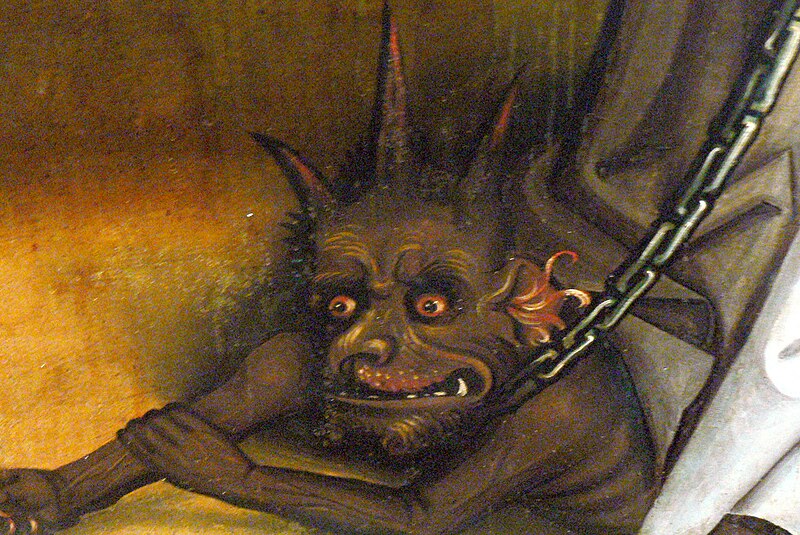
 The Synoptic Gospels are full of stories in which Jesus casts out demons. In Mark’s gospel, healing and exorcism are Jesus’ main activities. In the early church, exorcism was part of the pre-baptismal ritual. Throughout much of the world today, exorcism is a common part of Christian practice. Even in the United Methodist Church, our baptismal liturgy includes the question, “Do you renounce the spiritual forces of wickedness?”
 Yet in much of western Christianity, we tend to avoid any serious discourse on the subject of the demonic. If it does come up, we often talk about it as pre-modern myth made obsolete by modern science and medicine. Does this approach represent an intellectual and spiritual advance, or have we lost something important in the way in which we think and talk about evil?
Despite the fact that we avoid these topics in our churches, popular culture is rife with television shows, websites, and books devoted to the “paranormal.” It seems people are genuinely interested in these types of phenomena, and even open to affirming them as veridical. Why is it that the popular culture seems more open to the reality of spiritual phenomena than many of our churches are?
I’m particularly curious to know what, you, gentle readers, think about this matter. I’d appreciate your commenting below. Please, if you would, leave any comments here rather than on my Facebook page, so that all comments are available to all readers.
And let’s keep it civil, friends.
 David F. Watson
Thank you Dr. Watson for this blog. I have also encountered the demonic on United States soil and overseas. Invoking the name of Jesus with a strong faith causes them to leave. Why do I believe in the demonic and spiritual wickedness? Because it's Scriptural and because I've experienced them at work first hand.
Thank you Dr. Watson for this blog. I have also encountered the demonic on United States soil and overseas. Invoking the name of Jesus with a strong faith causes them to leave. Why do I believe in the demonic and spiritual wickedness? Because it's Scriptural and because I've experienced them at work first hand.
Britt,
Thank you for your comments. However I graciously beg to differ. I am very cautious with each case in which I believe a person is afflicted by the demonic. Many of the cases I have dealt with involving mental disorders or neurological conditions such as epilepsy (which clearly exists but is not as common as persons would purport, especially sweeping all demonic manifestations in the NT as such) are handled holistically and not merely passed off as the devil. This is a generalization. I encourage persons to seek medical care if they were not already doing so and would couple my prayer efforts together with the medical and/or therapeutic treatment they would receive. In one case a mother came to me with her son and described his manifestations. She wanted me to cast demons out of him. After hearing her describe the symptoms and interviewing her son, I concluded that I did not need to cast demons out of him but that she needed to take her son to a mental health professional for a diagnosis. She was irate with me because I refused to cast out devil. I let her know I am not qualified to make a diagnosis but my opinion was that it was Schizophrenia and the treatment would be therapy and the right pharmacology. The subsequent diagnosis proved to be the case. In other cases persons would come to me who had already been diagnosed, were in counseling, and were being treated. We would couple treatment with prayer and would always see positive results. In some cases, it involved the demonic, not as the sole cause. Causality can be complex and multiple. In such cases when I would minister deliverance, the symptoms would subside and the person would experience peace and progress in their walk with Christ. Persons who are experienced in deliverance and have some knowledge of the mental health professions (at least the referral system) will not fall into the false dichotomy that many of your Baptist friends did. It is not alway so cut and dry. Human anthropology is complex and so is the metaphysical world. Treatment also can involve a host of remedies working together. In cases of mental health I always put the medical profession first in my recommendation of treatment. Prayer and the work of the Spirit are offered to come along side. However, we are not merely physical beings, and creation is not merely physical. The Holy Spirit is a good Spirit. Medicine nor therapy can produce the Holy Spirit or his work, though the Spirit can use both. There are evil spirit too. Neither medicine nor therapy can exorcize evil spirits, but both can assist the work of the Spirit to accomplish this purpose. I do not want or choose to believe in demons. They are simply real and I have encountered them from my conversion experience out of atheism until this day – my deliverance from sin and conversion involved renouncing the devil as key to receiving Christ. Counseling and medicine could not help me at all at that time, and if I were left to those remedies 26 years ago, I would still be an atheist or worse. Evil is real. It is not merely chemical. And Jesus is real and so is the Holy Spirit. If we can find a medical cure to rid us of demons, maybe the world will also find a medical cure to rid their need of the Holy Spirit. Just being facetious. Bless you Britt. Thank you for the conversation.
I went to college with a very modernist and naturalistic world view that was formed by my mainline denominational upbringing. It was with extreme shock that I encountered numerous demonic manifestations that were undeniable to several credible witnesses. What was even more formational was seeing God's Word at work in overcoming the demonic power and bringing deliverance and peace to people and places. I'm now a UM pastor and demonic issues rarely come up directly in my ministry, but my firsthand experiences of Christ's victory over the demonic realm still significantly form how I approach preaching, praying, and leading.
Britt, there certainly are harmful approaches to the demonic that use enough scripture to make them nothing short of heretical. I recognize that many if not most illnesses (both physical and mental) are biologically-rooted, but there are some that are nothing short of demonic. It isn't common to see it in Euro-American culture given our modernistic mindsets, but once you've had to deal with it firsthand it really transforms your worldview. As a UM pastor I know I would have burned out with frustration long ago if I only had a naturalistic view of scripture and ministry. Having encountered God's victory over the darkness, my pastoral leadership is much more passionate and fruitful, so I'd name that as a very clear benefit for myself, my church, and community.