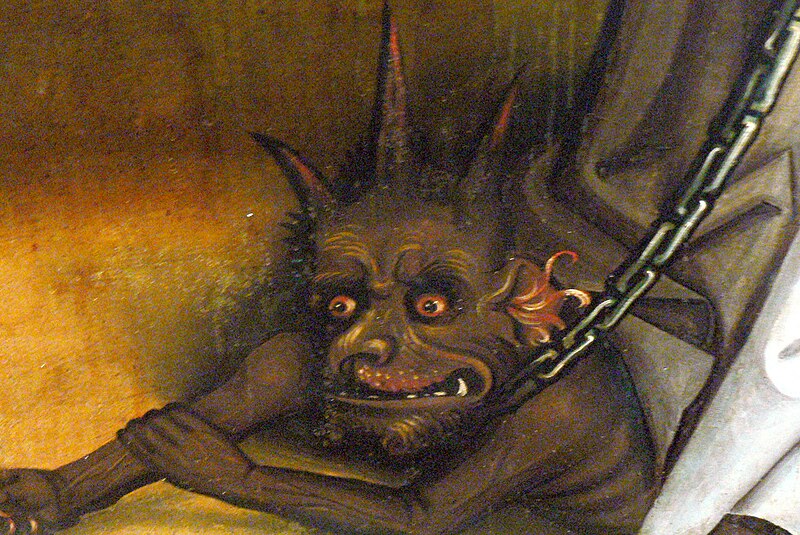
 The Synoptic Gospels are full of stories in which Jesus casts out demons. In Mark’s gospel, healing and exorcism are Jesus’ main activities. In the early church, exorcism was part of the pre-baptismal ritual. Throughout much of the world today, exorcism is a common part of Christian practice. Even in the United Methodist Church, our baptismal liturgy includes the question, “Do you renounce the spiritual forces of wickedness?”
 Yet in much of western Christianity, we tend to avoid any serious discourse on the subject of the demonic. If it does come up, we often talk about it as pre-modern myth made obsolete by modern science and medicine. Does this approach represent an intellectual and spiritual advance, or have we lost something important in the way in which we think and talk about evil?
Despite the fact that we avoid these topics in our churches, popular culture is rife with television shows, websites, and books devoted to the “paranormal.” It seems people are genuinely interested in these types of phenomena, and even open to affirming them as veridical. Why is it that the popular culture seems more open to the reality of spiritual phenomena than many of our churches are?
I’m particularly curious to know what, you, gentle readers, think about this matter. I’d appreciate your commenting below. Please, if you would, leave any comments here rather than on my Facebook page, so that all comments are available to all readers.
And let’s keep it civil, friends.
 David F. Watson
John, it depends on who the audience is. This is a sensitive subject and needs to be handled pastorally. When I address such issues in the Seminary classroom, I approach it from a missiological standpoint and address worldview.
I often point to the case study of Fuller Seminary when faculty from the World Missions and Evangelism department in the early 19080s (C. Peter Wagner, Charles Kraft, Alan Tippett and others) encountered the signs and wonders and power encounter ministry of John Wimber (founder of the Vineyard).
Wimber offered a class on signs and wonders at Fuller that turned that department upside down. Many of the leading faculty were former missionaries who operated out of an Enlightenment worldview and found their training inadequate to deal with power encounters from the folk religions on the mission field. Some of the faculty like anthropologist Charles Kraft had a Copernican revolution based on worldview shift. Much of Kraft's work at that time reflects this shift. Like Kraft, when I teach seminary students I approach it from worldview studies. Also see Paul Hiebert's work on the subject, especially “Transforming Worldviews.”
Our Enlightenment worldview of ratio-empiricism is dated, limited, flawed and inadequate to account for our experience and understanding of reality today. Even the field of science has recognized this fact over the last 100 years (ie. Einstein, Schroedinger, Heisenberg, Kuhn etc).
Again it depends on the audience as to which resources and approach I would use. For my own studies, I prefer to work out of field of philosophy and Continental phenomenology (Marion, Baudrillard, Gschwandtner, Henry, Levinas and others from this camp.
For lay folk, Charles Kraft has some resources even for laity. Father Francis MacNutt has some practical work as well. There is a ton out there for laity, much more than for scholars.
pb
Growing up as a Southern Baptist and in a fundamentalist environment, every bad thing was blamed on the Devil and demons. Even in Cincinnati at Hyde Park United Methodist Church, I heard an oncologist give an hour long talk on cancer and how the Devil was trying to kill her patients with cancer. Her proof? The Bible said so. The audience grew very uncomfortable with her ideas so I asked her, “Isn't fighting cancer scary and hard enough on its own without adding to that the belief that the most evil being in the universe is also trying to kill you??” In my opinion, belief in the Devil and “evil” is simply a device for projecting blame from ourselves or away from God, or to explain things we don't yet understand. It's also an easy excuse for doing nothing to solve challenging problems. Would we have made any advances in medicine or psychiatry if we just said, “That's the Devil's fault,”?
Thanks for your comments, Britt. I would only caution that we don't want to fall into the old “fallacy of the excluded middle.” In other words, the fact that some people blame everything on the demonic doesn't mean that we should do away with the category altogether.
David, I think a more important question is WHY believe in the demonic? Of what benefit is such a belief? Some observations above, while passionate and sincere, would just 100 years ago have been used to describe symptoms of epilepsy, multiple personality disorder, etc. If everyone simply attributed them to a demon then we wouldn't have the cures and treatments we do today. In my opinion, attributing suffering to demons holds us back, preventing us from providing healing and comfort that is our mission from God. Are there demons, or ghosts, or angels, or psychics, or extra-terrestrials? Who can say with certainty? It's interesting to speculate. But does believing in any of them provide any benefit? In my opinion, no. Can such belief be harmful or impede progress? In my opinion, yes.
There is a spiritual dimension to our work as pastors. Call it what you will, I have seen things I dare not report here and have done battle “for the hearts and souls” of others at times that without the Spirit would be impossible to overcome. I'm not sure what classified as “demonic” and like Britt I'm hesitant to speculate because I know that most of what we see today can be explained where it hasn't in the past. I guess I'll just say this, “I know the devil when I've seen him.” And he is alive and well…..at least for now. 🙂