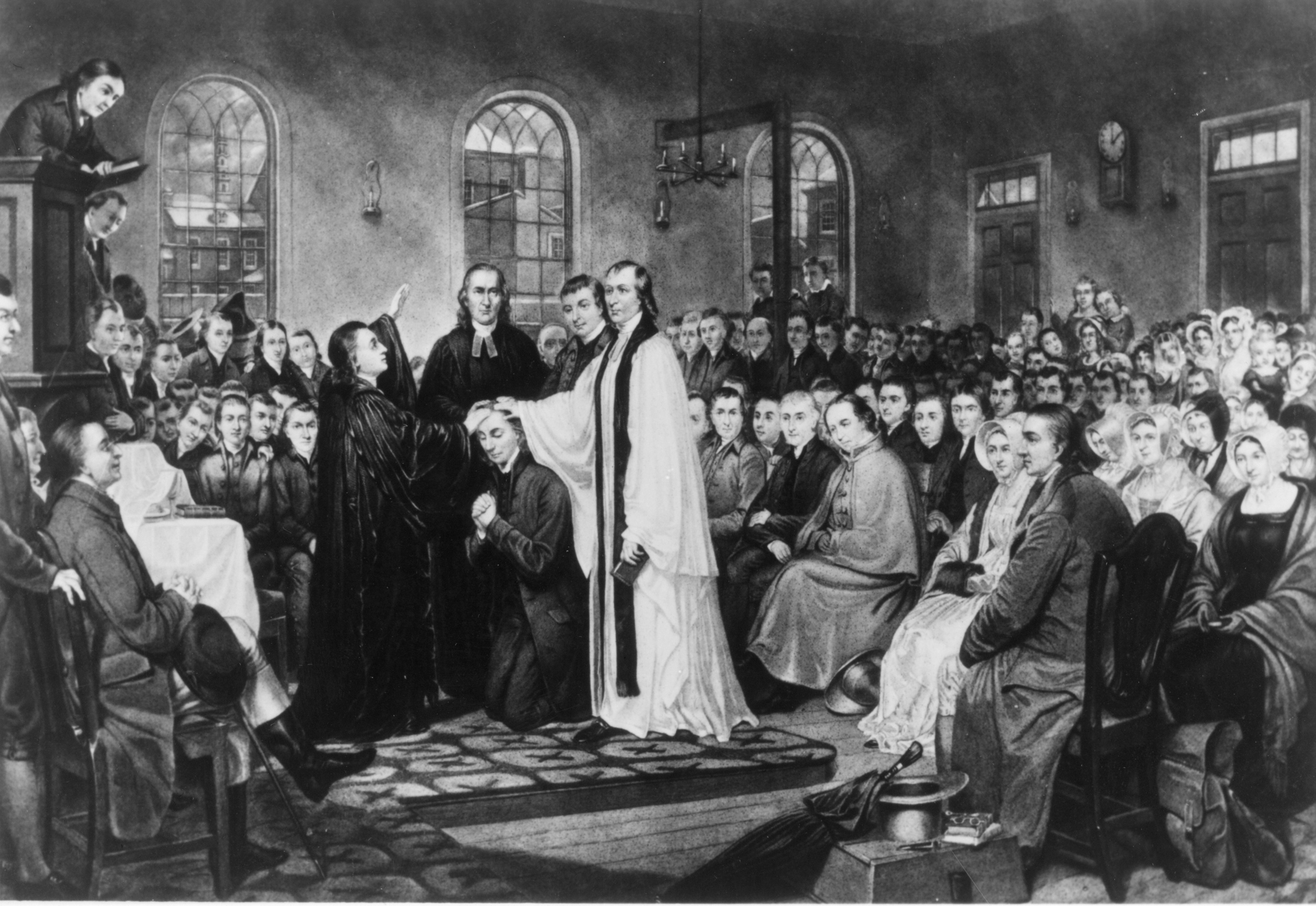
I’m an ordained elder in the West Ohio Conference of the United Methodist Church. My path to become ordained, however, was more difficult than it should have been. When I say this, I know that I echo the sentiments of many people who have gone through the ordination process in the UMC, whether they are seeking ordination as a deacon or an elder.
To be clear, I am not saying that ordination should be easy. Our standards for ordination should be high. I believe that the Church is the most important institution in the world, and the standards for ordained leadership in the Church should be commensurate with the importance of the Church. I am saying, however, that ordination should not be unnecessarily difficult.
When I was coming up through “the process” (please note: this was not in the West Ohio Conference) I was often told that I was “too intellectual” or some such thing.
Too intellectual? I was planning on a career as an academic.
Why, then, they would ask, do you want or need to be ordained?
This question always struck me as bizarre for two reasons. First, I was called to ordination. This sense of call was and is very clear to me. The fact that I didn’t articulate it in the same terms as the members of my District Committee, however, seemed to be problematic. Was I not emotive enough? Did I need to start crying? Did I not use the right code words? In retrospect, I realize that certain members of the committee had a set of informal and unstated criteria that they were using to assess my readiness for ordination. The problem was that the criteria were stated nowhere in the Discipline or in the candidacy materials that I had been given. The criteria were arbitrary.
Second, I could never figure out why so many of the people interviewing me saw congregational pastoral ministry as the only appropriate route for an elder. (My comments here will relate to the office of elder, since that’s where my experience lies, though this is in no way to diminish the significance of the order of deacon.) The Disciplineallows for extension ministries. Ostensibly, the UMC values these ministries. I was also puzzled, however, by the idea that we would want to take actions that would reduce the number of ordained elders in our colleges, universities, and seminaries. If the sacraments are means of grace, wouldn’t it be important to make these readily available to students in our UM institutions of higher learning? Don’t we want professors who care deeply about the church, the salvation of human beings, and the cultivation of holiness? What I was proposing to do was clearly within the boundaries of UM polity, but again the people interviewing me were utilizing informal and unstated criteria to make decisions about my readiness for ordination.
As I went before the Board of Ordained Ministry (also not in West Ohio—hey, I have to protect the innocent), I went to the committee that was to examine my theology and doctrine. One member of the interview team asked me, “You said in your paperwork that the Nicene Creed is the most important creed.” He looked at me with the suspicious glare of a detective questioning a suspect. “Who gets to decide what the most important creed is?” Another member of the committee began to nod in approval. “Yeah,” she said. “Who gets to decide that?”
Honestly, the question left me beyond puzzled. In terms of its historical importance, its formative effect upon later doctrine, its liturgical usage, its catechetical significance, the Nicene Creed is in a class by itself. So I asked—and I promise that it was an honest question—“What are the other options?”
“We’re the ones asking the questions here,” my interlocutor replied.
Oh. Ok. I get it.
Finally, I did make it through the process, and I have dedicated my vocation to serving the Church through a ministry of theological education. There were several times, though, when the process was so discouraging that I almost quit. Had it not been for a deep sense of calling, I’m sure that I would have. Make no mistake: there were very supportive people along the way. I owe a great debt to them. The process itself, though, was deeply problematic.
Since my ordination I have served on the District Committee for the Miami Valley District of the West Ohio Conference, as well as the West Ohio Conference Board of Ordained Ministry. I’ve reflected a great deal on the ordination process and the proper work of committees and boards who have oversight of the process. I have much more to say about this matter, but there is one item that I want to highlight in this post: the biggest problem with our ordination process is that it is not undergirded by a clear theology of ordination.
Begin with ¶ 301 in the Discipline. There is considerable discussion of what the ordained should do. There is little or no discussion of what ordination is. How can we have a fair process of ordination when we have no agreed upon theological understanding of what our bishops are doing when they ordain? It’s no wonder that our process is given to arbitrary criteria that can vary from conference to conference, team to team. As a church, we need to get clearer about what ordination is.
This would help us with another problem as well: clergy burnout. As a seminary professor and dean, one of the most common problems I see among my students is that they don’t know what the parameters of their jobs are. Too often, young pastors think that their job is everything. It isn’t. The primary role of a pastor is to bring people into relationship with God, to bring the Holy into the ordinary lives of women and men. Without without a clear sense of the ministry into which they are ordained, pastors will be much more prone to leave the ministry.
I’m currently heading up a team for my annual conference to review our candidacy and interview process. I know many of you reading this blog will have strong opinions about the ordination process. If you do, let me know what you think is working and what isn’t. Please help me to think constructively about this matter. I consider the work of this team to be very important, and I would very much appreciate any insights you may have to offer.
 David F. Watson
I'm a commissioned elder and hope the BoOM is called to recommend ordination in a few years. I definitely found a lot of push back at the district level. I hope to help plant new communities of people following Jesus Christ within our denomination. My committee thought I needed to spend a lot more time cultivating the shepherding gifts seemingly unimpressed by the apostolic or evangelistic. (This isn't a pipe dream; I have a track record!) Other folks told me afterwards that none on the committee had planted a church so of course they didn't understand you. Starting new vs serving long established requires a very different mindset. The impulse of several on the committee seemed to be “we need to make him more like us.”
At the risk of offending: one of the things that has bothered me the most about seminary professors and ordained college professors with extension ministry appointments is to discover just how many of them have no regular participation in a local UM church. I'm not talking working as an assistant pastor, but simply being a regular worshiper, active in (or even available to) an adult Sunday School class, or being available to help with the sacraments or to fill in if the pastor become ill.
I don't think it is unreasonable to ask that all who are ordained in the UMC (unless retired and no longer physically or mentally able so to participate) have not only a charge conference relationship, but can show some level of regular or even semi-regular participation in a local UMC church.
Particularly, I have wondered if it would be reasonable to expect that UM clergy who teach in one of the UM seminaries approved by the University Senate have to provide their Dean with a certificate from the the pastor of the local church in which they participate, attesting to their regular participation. If we expect ordained clergy to train our incoming clergy, (whom we demand have regular participation in a local church), is it not unreasonable to ask that those to do the training have the same sort of requirement.
Perhaps I am jaded by recalling the late L. Harold DeWolf, who believed that if he could not make the Gospel relevant to children, he had no business teaching it in a seminary. For years, he was a regular teacher in the Kindergarten Sunday School class at the church which he attended. Bravo for him!
David,
When I was looking towards doctoral studies I ran into the exact kind of conversations you name in my DCOM. It's as if anyone who feels called to be an elder is only allowed, while undertaking the Process, to say they are called to be parish pastors. Anyone who cannot or will not say they will be appointed wherever as a pastor should thus be a deacon. My friends, this should not be. My own, more general thoughts on the Process are listed below (I was just ordained in June myself). Thanks for your thoughts. http://pastormack.wordpress.com/2013/05/06/cumbersome-by-design-thoughts-on-the-process/
Your experience touches a raw nerve for me, so I'll simply say that yours is not an isolated experience. Thankfully, there are boards of ordained ministry outside the USA with broader views on what it means to be a pastor.
Rev. Taylor Denyer
Elder, The UMC's North Katanga Conference
David,
I've (so far) had an encouraging, meaningful journey along this process. I went from inquiring as a candidate to commissioning in the order of elder in 4 years (that included seminary), and, from what I've gathered from colleagues, that is remarkably quick. Part of why I believe I've fared so well (while being surrounded by others' horror stories about the process) is because I've been very clear about my call to local church ministry; I know that is where God has given me gifts and graces. I could tell that was what my dCOM and BOOM were looking for – an articulation of a local church ministry call, NOT to an extension ministry or to higher education. To me, that is a betrayal of Wesley's vision of the world as the parish.